How spray-dry encapsulation works
The idea is to trap a delicate flavour oil inside a protective shell so it survives processing and storage. With gum arabic it happens in four steps:
- Emulsify. The flavour oil is emulsified into a gum arabic solution, which coats each oil droplet.
- Atomise. The emulsion is sprayed into a fine mist inside a hot drying chamber.
- Dry. The water flashes off in seconds, too fast to cook the flavour.
- Set. The gum sets into a glassy matrix around each droplet, giving a dry powder that protects the flavour from oxygen and evaporation.
Gum arabic suits this better than most carriers because it does two jobs at once: it is a natural emulsifier and a film former, with high solubility, low viscosity at high solids and a neutral taste.
"It is used as a natural emulsifier and stabiliser in beverages and confectionery and for flavour encapsulation."
Typical spray-drying parameters
The question we get asked is not what encapsulation is, it is what numbers to start from. These are conventional starting points from the encapsulation literature, not a specification. Every oil, every dryer and every throughput behaves differently, so treat them as a first trial and validate on your own system.
| Parameter | Common starting point | What moves it |
|---|---|---|
| Wall material | Gum arabic alone, or blended with maltodextrin | Blending cuts cost, but every point of maltodextrin removes emulsifying capacity |
| Oil load | Around 20% of total solids, so roughly one part core to four parts wall | Higher loads raise surface oil and shorten shelf life |
| Feed solids | 30 to 40% | Gum arabic stays pourable at solids where other hydrocolloids thicken or gel, which is most of why it is used |
| Emulsion droplet size | Around one micron | Finer droplets retain more flavour and leave less oil on the particle surface |
| Homogenisation | Two stage, coarse then fine | A single coarse pass is the usual cause of poor retention |
| Inlet air | 160 to 200 C | Set by throughput and the heat sensitivity of the flavour |
| Outlet air | 80 to 100 C | Too low leaves residual moisture, too high bakes the surface |
What usually goes wrong
- Surface oil. Free oil on the particle surface oxidises first and is what people smell in a stale powder. Usually an oil load pushed too high, or an emulsion droplet left too coarse.
- Stickiness in the chamber. Powder building on the wall or refusing to flow is normally a low glass transition temperature, which sugars and low molecular weight carriers make worse.
- Poor retention. Flavour lost during drying rather than in storage usually points at feed solids that are too low, so the crust forms too slowly to seal the droplet.
Tell us the oil, the load you are targeting and the dryer you are running, and we will tell you honestly whether hashab alone is the right carrier or whether you would be better blending it.
Gum arabic vs maltodextrin and modified starch
An honest comparison, because formulators often blend carriers rather than pick one:
| Carrier | Strength | Trade-off |
|---|---|---|
| Gum arabic | Natural emulsifier and film former, neutral taste, clean label | Higher cost, often blended for economy |
| Maltodextrin | Cheap, high solids loading | Not an emulsifier, so needs help holding oils |
| Modified starch | Strong emulsifier, high load | Chemically modified, not clean label |
Why Sudanese hashab
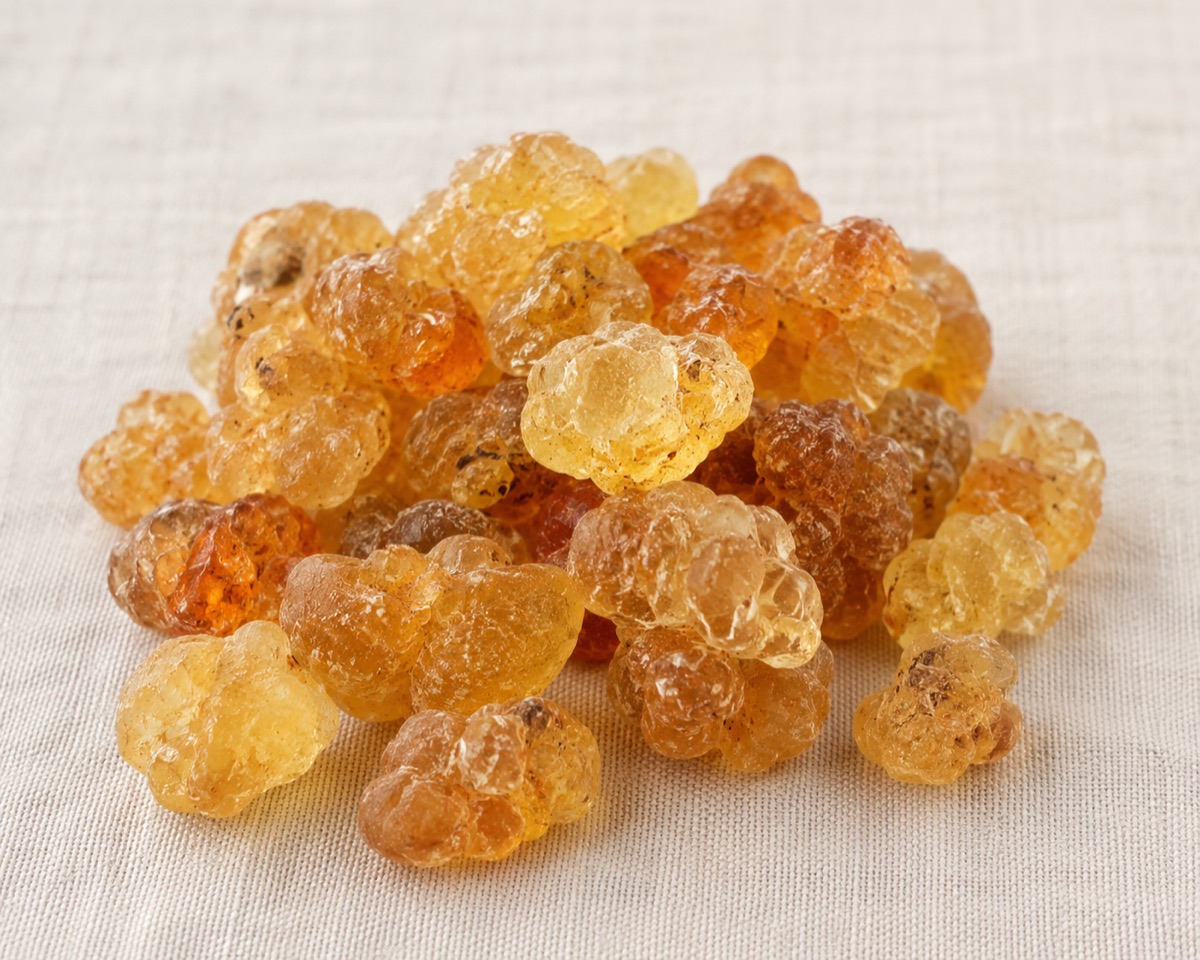
Encapsulation performance comes from the emulsifying grade. Hashab, the gum of Acacia senegal, is the grade with the high solubility and superior emulsifying properties that encapsulation depends on. Ours is grade one hashab from Sudan, bought at origin rather than through a UK distributor. It is plant based and suitable for vegan and vegetarian and halal products.
"Gum Senegal: derived from the Acacia Senegal tree; this type is known for its high solubility in water and superior emulsifying properties."
What we encapsulate and supply
- Spray-dried flavours and flavour systems
- Encapsulated colours
- Citrus and essential oils, and oil-soluble actives
- Dry beverage and confectionery mixes
We supply spray-dried and milled powder for direct use, and cleaned raw gum (whole or kibbled) for producers running their own spray-dry line. All grade one, food grade, labelled E414, from 25 kg bags to pallet lots with specification and batch documentation.